
How to Select a Compressed-Air Dryer and Dew Point
How to Select a Compressed-Air Dryer and Dew Point
A practical buyer’s guide to refrigerated and desiccant dryers, pressure dew point, sizing corrections, filters, drains, installation and acceptance testing.
Key takeaways
- Start with the process air-quality requirement.
- Specify pressure dew point, not vague “dry air”.
- Correct dryer capacity for worst-case inlet conditions.
- Verify dew point and pressure loss after installation.
What pressure dew point means
Pressure dew point (PDP) is the temperature at which water vapour begins to condense at the stated compressed-air pressure. A lower PDP means drier air. It is different from atmospheric dew point, so the measurement basis must be clear. Select PDP from the process risk and the lowest pipe temperature—not from habit.
Define the process requirement
General workshop tools may tolerate air from a correctly selected refrigerated dryer, while instrumentation, electronics, outdoor lines in cold conditions, powder handling or sensitive processes may need a lower PDP. Product-contact applications may also have particulate and oil limits. Document the requirement at each point of use and consult relevant quality standards and equipment suppliers.
Refrigerated dryers
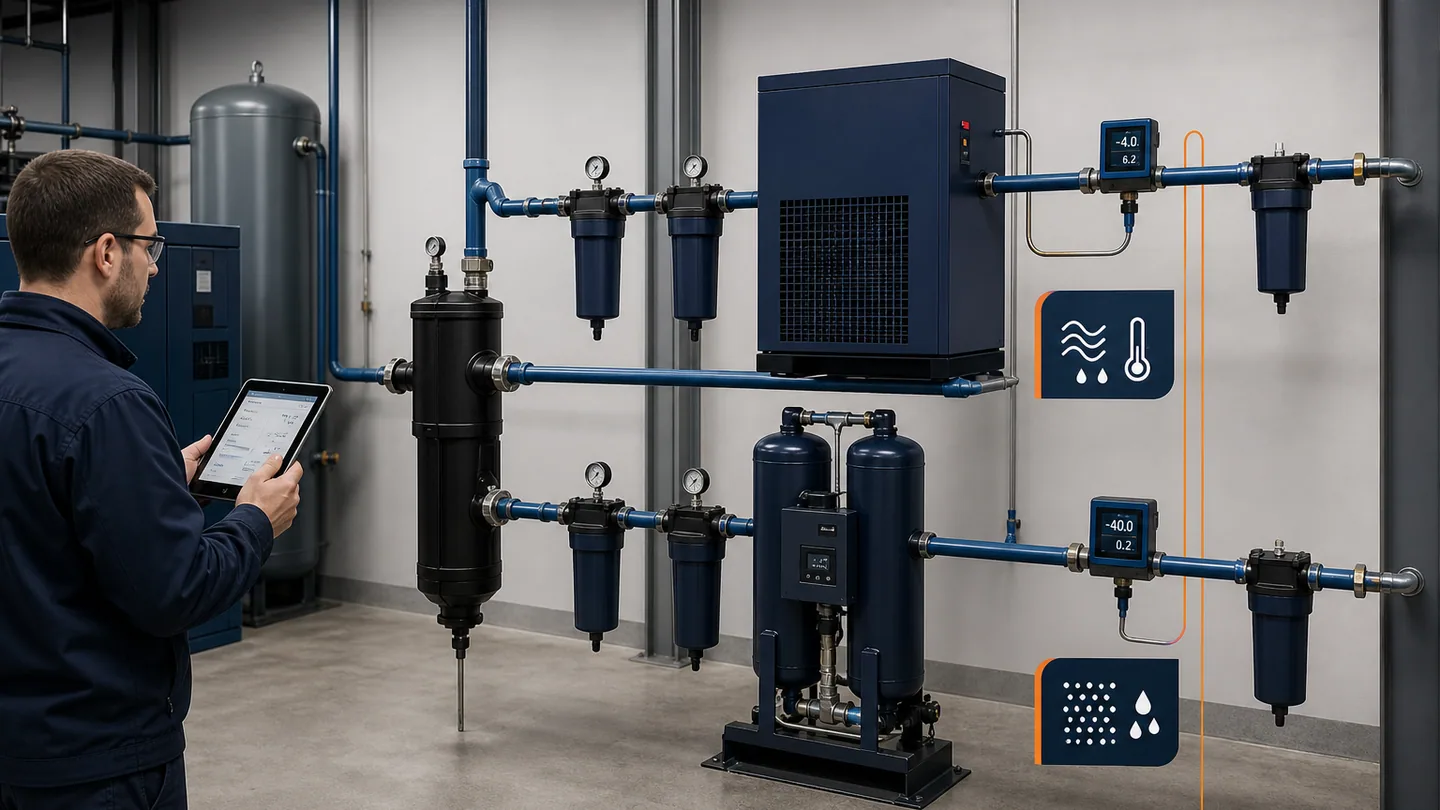
Refrigerated dryers cool compressed air so moisture condenses and can be separated and drained. They are widely used for general industrial air where a moderate positive PDP is acceptable. Selection must account for inlet temperature, ambient temperature, pressure and flow. They need effective condensate separation, a functioning drain and adequate ventilation.
Desiccant dryers
Desiccant dryers adsorb water vapour and can achieve much lower PDPs. Heatless, heated and blower-purge designs differ in purge-air use, energy, controls and maintenance. Inlet liquid water or oil can damage desiccant performance, so upstream separation and filtration are critical. Include purge demand when sizing compressor capacity and evaluating operating cost.
Technology comparison
| Question | Refrigerated | Desiccant |
|---|---|---|
| Typical use | General plant air | Low-dew-point processes |
| Energy considerations | Refrigeration power | Purge loss and/or heater/blower power |
| Inlet protection | Water separation and filtration | Strong water/oil protection essential |
| Maintenance | Drains, condenser, refrigeration circuit | Valves, filters, desiccant and dew-point control |
Actual capability varies by product and conditions; use certified supplier data rather than the table as a performance guarantee.
Correct the rated capacity
Catalogue flow is usually stated at reference conditions. High inlet temperature, high ambient temperature, lower pressure or a stricter dew point can reduce capacity. Apply the manufacturer’s correction factors for the worst credible simultaneous condition. Size pre-filters, after-filters, drains and bypasses for the same design flow and pressure.
Plan the treatment train
A typical arrangement may include aftercooling and separation, wet receiver, pre-filtration, dryer, after-filtration and dry receiver, but the correct order depends on compressor type, dryer technology and process. Provide isolation and a secure bypass policy; an accidentally open bypass can send wet untreated air to production. Route condensate for compliant treatment and disposal.
Specify monitoring and acceptance
- State required PDP and measurement location.
- Define maximum flow, pressure, inlet and ambient temperatures.
- State allowable pressure drop with clean and service-limit filters.
- Provide dew-point indication/alarm for critical processes.
- Test drains, separator and bypass position.
- Record PDP over representative operation, not only at start-up.
Avoid common buying mistakes
Do not select from pipe connection size alone, confuse atmospheric and pressure dew point, ignore compressor oil/water carryover, omit purge demand, or assume a dryer fixes liquid water already collecting in poorly designed piping. Review the complete system, including the factory compressed-air design guide.
Frequently asked questions
Is a lower dew point always better?
No. Lower PDP usually costs more to produce. Specify only what the process, environment and reliability risk require.
Why does water appear after a dryer?
Possible causes include overload, high inlet temperature, failed drains, open bypass, poor separation, unsuitable PDP or downstream cooling below PDP.
Can one dryer serve every process?
Sometimes, but a low-dew-point process may be better served by local treatment instead of drying the entire plant to the strictest requirement.
Do desiccant dryers consume compressed air?
Many designs use purge air; the amount depends on technology and controls. Include it in capacity and operating-cost calculations.
Review your compressed-air requirement with ITT India.
Share your process, demand profile, pressure, air-quality requirement and plant location. Our team can help you plan the next technical step without unsupported performance claims.