
7 Signs Your Compressed-Air System Needs Servicing
7 Signs Your Compressed-Air System Needs Servicing
Seven operational warning signs that help maintenance teams distinguish compressor, air-treatment and distribution problems before they become unplanned downtime.
Key takeaways
- Trend pressure, temperature, power and run hours.
- Investigate a change from the normal baseline.
- Check the entire system—not only the compressor.
- Follow the manufacturer’s maintenance schedule and safety procedures.
1. Pressure drops during production
Slow cylinders, weak tools and nuisance machine alarms often appear first at the point of use. Compare pressure at the receiver, after treatment equipment and at the affected machine while demand is high. A clogged filter, undersized pipe, partially closed valve, leak or demand spike can create the same symptom as insufficient compressor capacity.
2. New noise or vibration
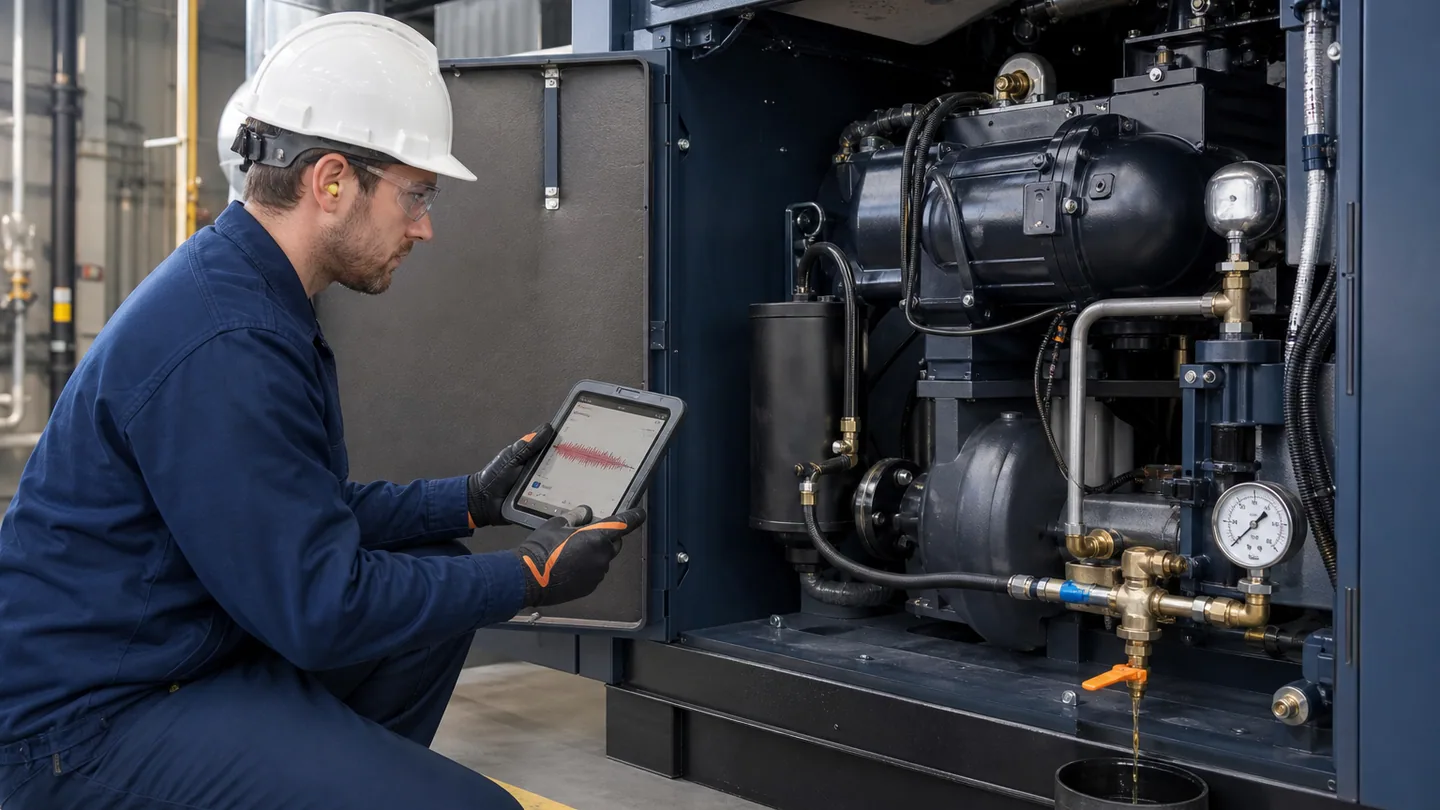
Knocking, rattling, grinding, belt squeal or a change in vibration requires prompt inspection. Causes can include loose fasteners, worn bearings, misalignment, belt wear or an abnormal air-end condition. Record where and when the noise occurs, then isolate and lock out equipment before physical inspection. Do not operate with guards removed.
3. Moisture reaches the air line
Liquid at drains or tools can indicate a failed drain, overloaded separator, high dryer inlet temperature, insufficient dryer capacity or a dew-point problem. Moisture can promote corrosion and affect valves, instruments, paint and product quality. Check drains, aftercooler performance, filters and dryer operation as a system.
Use the dryer and dew-point guide to identify the air quality your process actually needs.
4. Energy use rises without matching output
Compare compressor energy and run hours with production volume. A rising ratio can point to leakage, higher pressure settings, dirty coolers or filters, inappropriate sequencing, long unloaded run time or deteriorating performance. Electricity bills alone are not a diagnostic tool, but a stable baseline makes abnormal change visible.
5. The compressor runs longer or cycles rapidly
Longer loaded hours may indicate increased legitimate demand or leaks. Rapid load/unload or start/stop cycling can indicate an unsuitable pressure band, inadequate storage, control issues or a mismatch between compressor capacity and demand profile. Review controls and receiver capacity before adjusting setpoints.
6. Hissing or confirmed leaks
Audible leaks deserve repair, but many leaks cannot be heard in a working plant. Use an ultrasonic survey during production and, where possible, a shutdown pressure-decay or no-production load test. Tag each leak with location, size estimate and repair status. The leak audit guide provides a repeatable workflow.
7. Air-powered machines become inconsistent
Intermittent speed, poor finish or actuator faults may come from point-of-use regulators, lubricators, hoses, valves, contamination or pressure instability. Check the machine requirement and local components before increasing system pressure. Raising the whole network for one poorly supplied machine can waste energy and increase leakage.
Service checklist and escalation
- Review alarms, temperatures, pressure, run hours and service history.
- Inspect intake, oil and separation elements according to the OEM schedule.
- Check belts, couplings, coolers, ventilation and electrical connections.
- Test condensate drains and inspect dryer/filter differential pressure.
- Survey leaks and verify point-of-use pressure under load.
- Record corrective action and establish a new baseline.
Frequently asked questions
How often should a compressor be serviced?
Use the manufacturer’s hour- and time-based schedule, adjusted for dust, heat, humidity, loading and operating conditions.
Does low pressure always mean a larger compressor is needed?
No. Measure pressure at several points first; restrictions, leaks, controls and distribution losses are common causes.
Can plant staff repair every air leak?
Only trained staff should work within their competence and site safety rules. Isolate, depressurise and verify zero energy before repair.
Review your compressed-air requirement with ITT India.
Share your process, demand profile, pressure, air-quality requirement and plant location. Our team can help you plan the next technical step without unsupported performance claims.