
Understanding Pressure Drop in Compressed Air Piping: Causes and Fixes
Why undersized, congested piping quietly drains compressor output — and the practical fixes that recover pressure without adding compressor capacity.
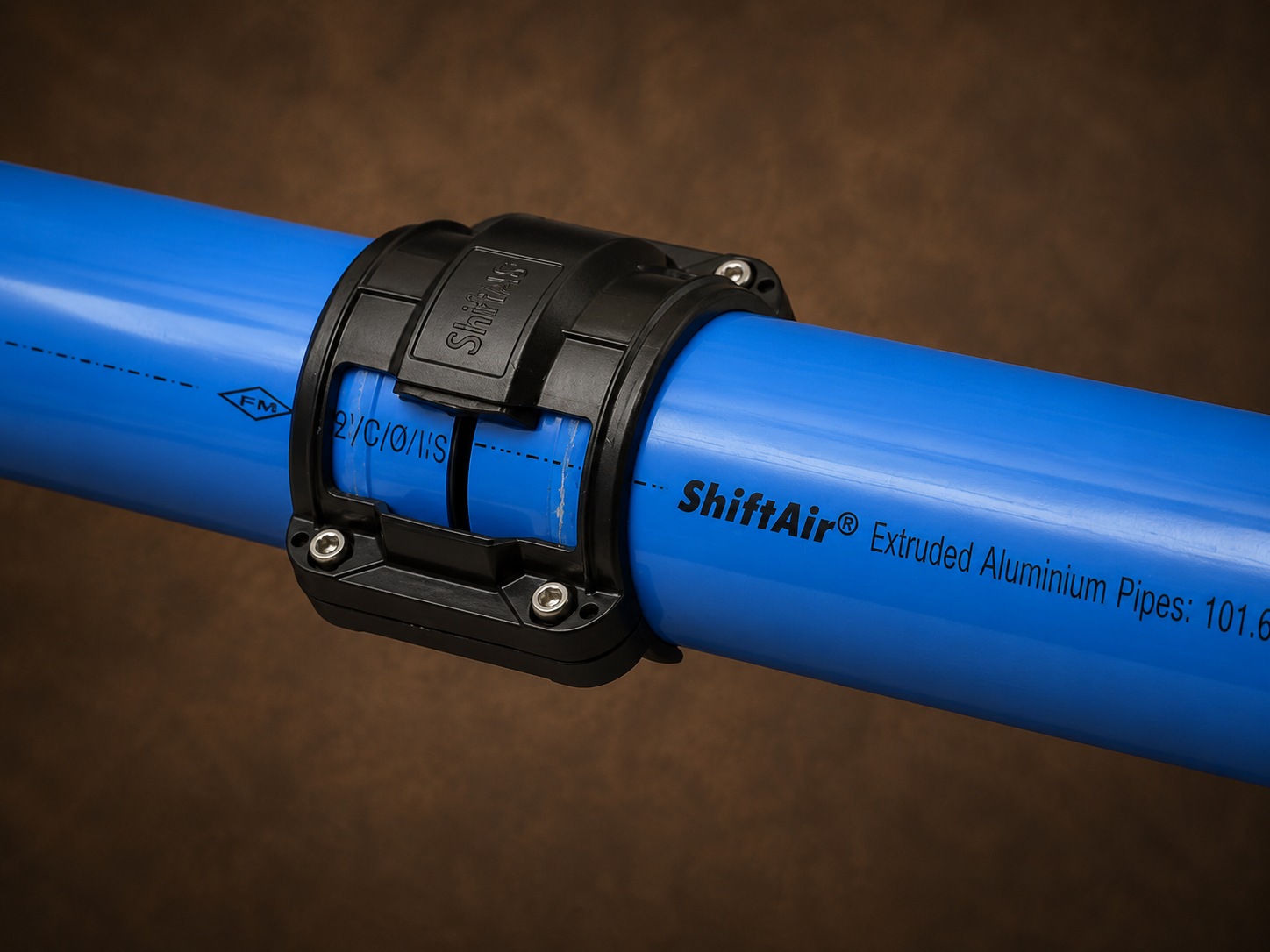
Most plants react to a compressed-air shortage by looking at the compressor first — checking capacity, cleaning filters, or asking whether it's time to add a second machine. But in a large number of cases, the compressor is producing exactly what it should. The air is simply losing pressure on the way to the point of use. That loss is called pressure drop, and unlike a leak, it doesn't waste air — it wastes the pressure the air is carrying, which is just as expensive.
What pressure drop actually costs you
Every bar of unnecessary pressure drop between the compressor and the tool or machine forces the compressor to work at a higher discharge pressure to compensate — typically adding 6–8% to energy consumption for every extra bar. Beyond the electricity bill, it shows up as inconsistent tool performance, slower cycle times on pneumatic equipment, and operators nudging the compressor's set pressure higher "just to be safe," which raises leakage rates and running costs across the entire network.
A well-designed compressed-air system should lose no more than about 0.1–0.3 bar across the whole distribution network, from the compressor room to the farthest point of use. Many older Indian factory networks, especially those still running on galvanised iron (GI) pipe, lose several times that.
Common causes of excess pressure drop
Undersized pipe diameter
Pipe sized for the compressor's original capacity often can't cope once a plant adds machines or extends a line. Air velocity that's too high for the pipe bore creates turbulence and drag that scales sharply with distance — doubling the flow through the same pipe roughly quadruples the pressure loss.
Too many fittings, elbows and valves
Every 90° elbow, tee, reducer or ball valve adds resistance equivalent to several metres of straight pipe. Networks built up over years of ad-hoc extensions tend to accumulate far more fittings than a network designed as one system from the start.
Long, winding branch runs
Dead-end branches that snake around a building — rather than dropping from a central ring main — multiply both length and fittings, compounding the first two problems.
Corrosion and scale inside old GI pipework
Galvanised and mild-steel pipe corrodes internally over time. The resulting scale narrows the effective bore and roughens the internal surface, increasing friction loss well beyond what the nominal pipe size would suggest — often the single biggest culprit in networks more than eight to ten years old.
Leaks compounding the problem
Leaks don't directly cause pressure drop, but they add uncontrolled downstream demand that pushes more air through an already-restrictive network, making any existing drop worse at the exact moments the plant needs pressure most.
Fit a pressure gauge at the compressor outlet and another at the farthest or most problematic point of use. Compare readings with the plant running at normal load. A difference above roughly 0.3 bar signals a distribution problem worth investigating, not a compressor problem.
Practical fixes
- Right-size the ring main up front — size pipe diameter for projected future demand, not just today's load, since re-piping later costs far more than a larger pipe does now.
- Favor low-friction materials — aluminium and PPR-C piping keep a smooth internal bore permanently and never corrode internally, unlike GI or MS pipe.
- Minimise elbows and use sweeping bends — where a direction change is unavoidable, a long-radius bend causes markedly less turbulence than a sharp 90° elbow.
- Design a loop or ring main instead of long dead-end branches, so demand can be met from two directions and peak flow through any one section is reduced.
- Run a leak audit alongside any piping review — fixing piping while leaks remain unaddressed only masks part of the problem.
When to call an engineer
If gauge readings show a persistent gap between compressor output and point-of-use pressure, the fix is rarely "buy a bigger compressor." A plant survey that maps pipe runs, fittings, materials and actual demand will usually identify exactly where pressure is being lost — and whether a partial re-pipe of the worst-affected sections, rather than a full network replacement, is enough to recover it.
Not sure how much pressure your plant is losing?
Share your pipe layout, materials and current pressure readings — ITT India's engineers will help you find the fix.