
Screw vs Reciprocating Compressor: How to Choose the Right One
Piston or rotary screw? The right answer depends less on the machine and more on how your plant actually uses air — duty cycle, demand pattern, air quality and total cost of ownership.
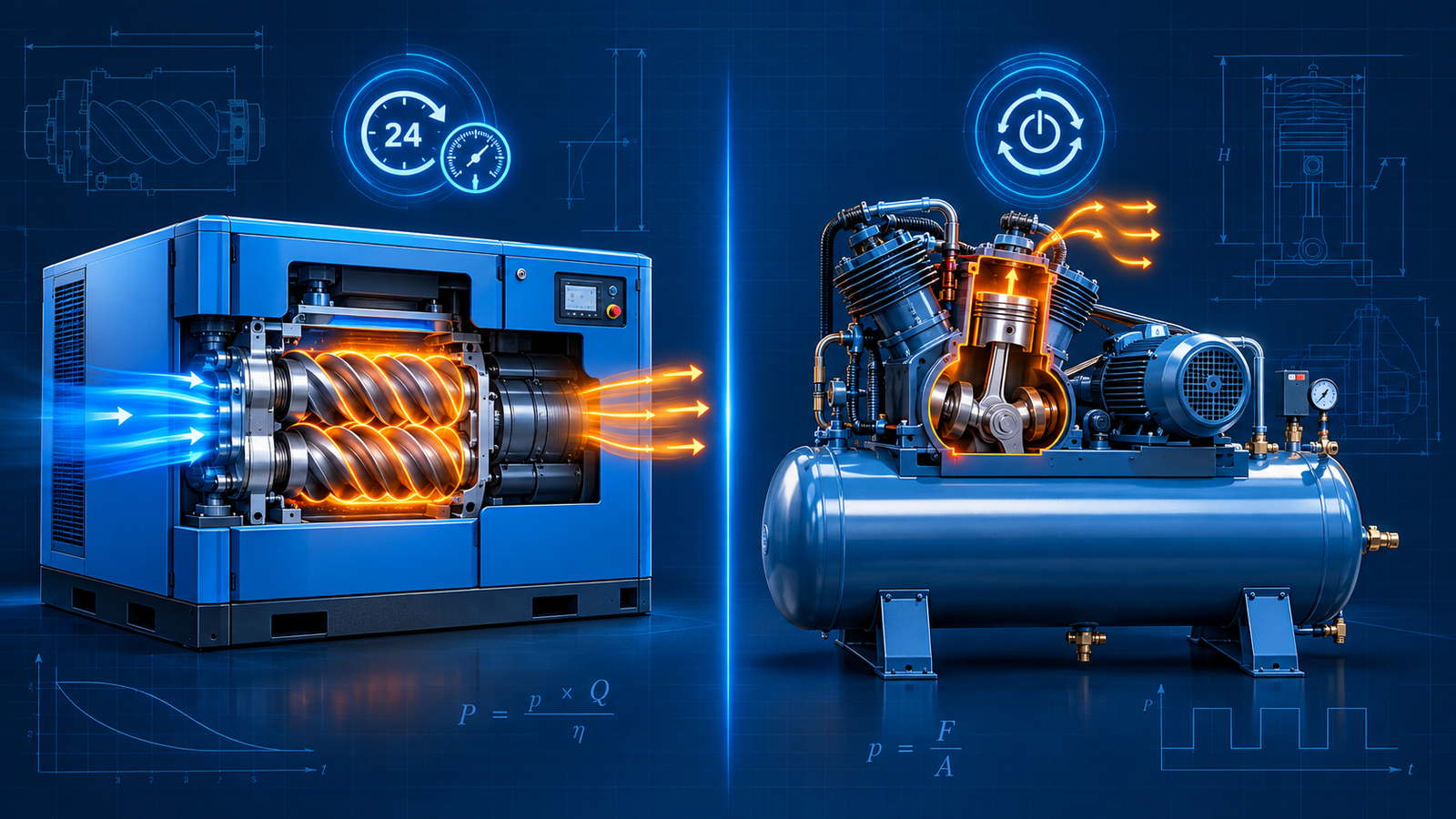
When a factory needs a new air compressor, the first question is usually "screw or reciprocating?" Both compress air reliably, and both are widely used across Indian industry. But they are built for different jobs. Choosing the wrong type rarely shows up on day one — it shows up a year later as high power bills, overheating, frequent overhauls or air that's too wet and oily for the process.
This guide explains how each technology works, where each one makes sense, and the questions to answer before you buy.
How each compressor works
Reciprocating (piston) compressor
A reciprocating compressor uses a crankshaft to drive one or more pistons inside cylinders — much like an engine. Air is drawn in on the down-stroke and compressed on the up-stroke, then pushed through valves into a receiver tank. Two-stage machines compress in two cylinders with intercooling in between to reach higher pressures efficiently. Air delivery is naturally pulsating, which is why piston compressors are almost always mounted on or paired with a receiver.
Rotary screw compressor
A rotary screw compressor uses two meshing helical rotors. As they turn, air is trapped in the pockets between the rotor lobes and progressively squeezed into a smaller volume toward the discharge end. Most industrial screw compressors are oil-injected: oil seals the rotor clearances, removes compression heat and is then separated from the air before it leaves the package. Delivery is smooth and continuous, and the machine is designed to run for long periods without stopping.
The single biggest factor: duty cycle
Duty cycle is the percentage of time the compressor is actually running and loaded. It matters more than any other factor in this decision.
- Reciprocating compressors are built for intermittent duty. Most air-cooled piston units are intended to run somewhere around 50–70% of the time, with rest periods to shed heat. Run them continuously and valve temperatures, oil carry-over and wear rise quickly.
- Screw compressors are built for continuous duty. They are designed to run at or near 100% duty all shift, every shift. What they dislike is the opposite — very short, frequent run cycles, which stop the oil reaching full operating temperature and let moisture condense inside the machine.
In simple terms: if your plant needs air steadily for most of the day, a screw compressor fits the demand. If air is needed in short bursts — a workshop, a tyre shop, a small fabrication unit running a few tools occasionally — a reciprocating compressor usually fits better.
Side-by-side comparison
| Factor | Reciprocating (piston) | Rotary screw |
|---|---|---|
| Best-fit duty | Intermittent, stop-start demand | Continuous, steady demand |
| Typical size range | Small to medium flows; common up to ~15–20 kW | From ~5 kW up to several hundred kW |
| Purchase price | Lower for the same small capacity | Higher up front |
| Energy efficiency | Reasonable at small sizes; drops as wear increases | Better specific power at medium–large sizes; VSD models track variable demand well |
| Air delivery | Pulsating; needs a receiver | Smooth and continuous |
| Discharge temperature & oil carry-over | Higher, and rises with age and wear | Lower and more stable (with a good separator) |
| Noise & vibration | Louder; usually needs a separate room or foundation | Quieter enclosed package; can sit closer to the shop floor |
| Maintenance | Frequent: valves, rings, belts, oil | Scheduled service at longer intervals; fewer wearing parts |
| Lifecycle cost | Lowest when running hours are low | Usually lowest when running hours are high |
Energy: where the real money goes
Over a compressor's working life, electricity is typically the largest cost — often far larger than the purchase price. That is why a cheaper machine can become the more expensive choice.
A useful way to compare machines is specific power: the kW of input power needed per unit of free air delivered (for example kW per m³/min or kW per 100 cfm) at your working pressure. Always compare specific power at the same pressure, using the manufacturer's tested FAD figures rather than displacement. Piston compressors are often quoted by displacement, which overstates the air you actually receive — use our FAD calculator to check real delivery.
For plants running two or three shifts, a well-sized screw compressor — especially a variable speed drive (VSD) model where demand fluctuates — generally pays back its higher price through lower energy use. For a unit running an hour or two a day, the energy difference may never recover the extra investment.
If the compressor will run more than about 4–6 hours a day, or your demand is above roughly 15–20 kW worth of air, start by evaluating a screw compressor. Below that, with short intermittent use, a good two-stage reciprocating compressor is often the more economical choice. Treat these as starting points, not hard limits — your actual demand profile decides.
Air quality, heat and noise
Reciprocating compressors discharge hotter air, and as rings and valves wear, oil carry-over tends to increase. That puts more load on downstream dryers and filters. Screw compressors deliver cooler, more consistent air with lower oil content, which makes air treatment easier to size and maintain. For oil-sensitive processes — food, pharma, electronics, painting — neither lubricated type should be relied on alone: plan proper filtration, or consider an oil-free machine.
Noise and space matter too. Piston compressors vibrate and are loud enough that they are normally placed in a separate room or outside the building. A modern enclosed screw package runs much more quietly and can often be installed near the point of use, which also shortens pipe runs and reduces pressure drop.
Maintenance and downtime
Reciprocating compressors have many moving and wearing parts — valves, piston rings, bearings, belts — and need frequent attention. They are simple, and local technicians can usually service them. Screw compressors have fewer wearing parts and longer service intervals (oil, filters, separator element on a schedule, with an airend overhaul after many thousands of hours), but when major work is needed it calls for trained service and genuine spares. Factor your service support into the decision, not just the machine.
Questions to answer before you buy
- How many hours a day will the compressor run, and how steady is the demand across the shift?
- What flow and pressure do you actually need at the point of use, including future expansion? Measure it or calculate it from connected equipment.
- What air quality does the process require — moisture, oil and particle limits?
- Where will the compressor be installed, and what are the noise, ventilation and space limits?
- What is your electricity tariff, and what is the expected total cost over 5–10 years, not just the purchase price?
- Who will service it, and how quickly can spares be obtained?
The bottom line
Choose a reciprocating compressor for low running hours, intermittent demand, small capacities and tight budgets. Choose a rotary screw compressor for continuous or multi-shift operation, medium-to-large demand, lower noise and the lowest lifetime energy cost. Many plants also use both: a screw compressor for base load and a smaller piston unit for occasional peaks or a remote workshop.
If you're unsure, a short demand study — measuring actual flow and running hours for a week — usually makes the right choice obvious and prevents over- or under-sizing whichever technology you pick.
Not sure which compressor fits your plant?
Share your air demand, running hours and application — ITT India's engineers will recommend the right technology and size.