

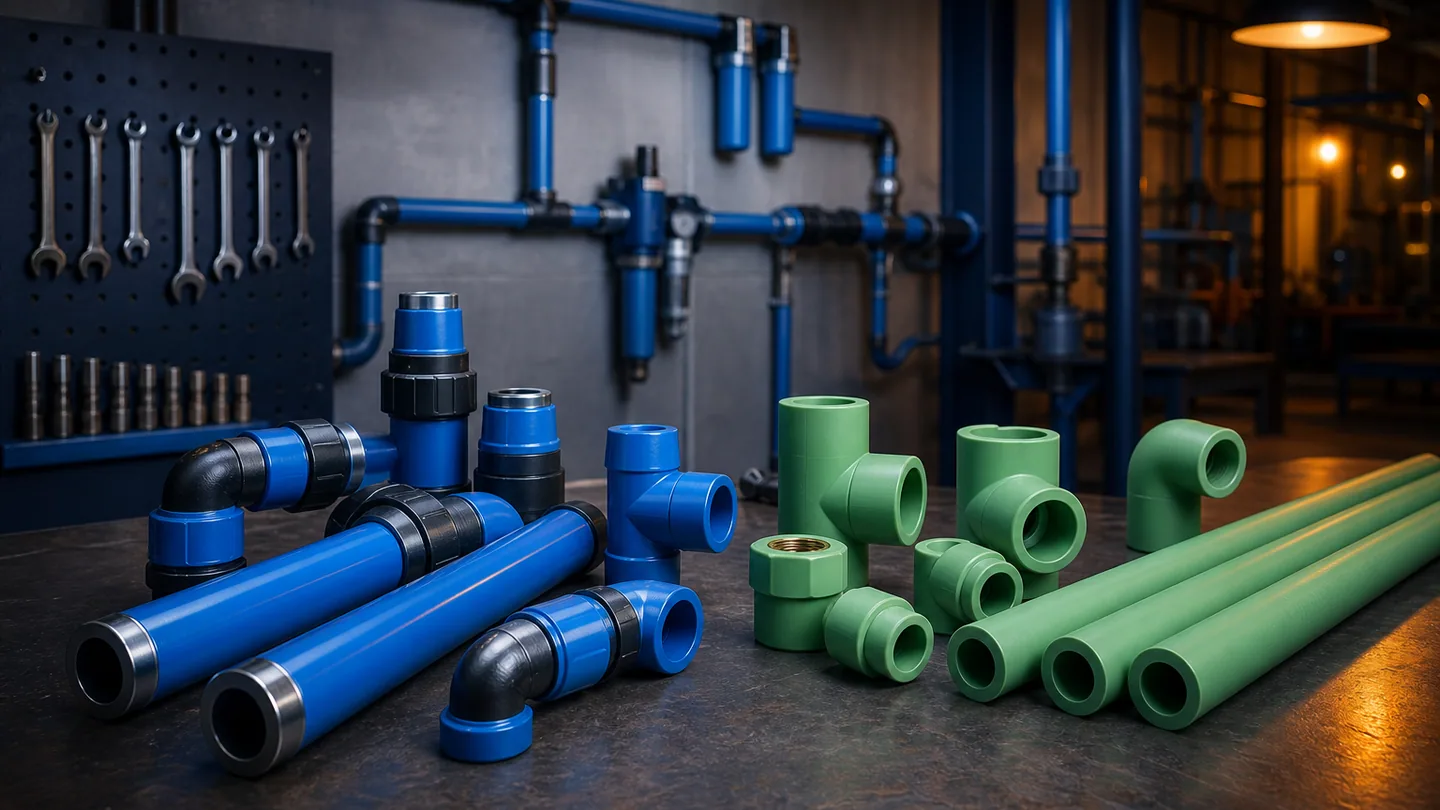
Aluminium vs PPR Piping for Industrial Compressed Air
Aluminium vs PPR Piping for Industrial Compressed Air
A balanced comparison of aluminium and PPR compressed-air piping, covering pressure rating, temperature, joints, expansion, safety, maintenance and whole-life selection.
Key takeaways
- Use only pipe explicitly approved for compressed gas service.
- Check pressure rating at the highest expected temperature.
- Evaluate joints, supports, expansion and future modifications.
- Compare installed life-cycle cost, not pipe price alone.
Start with safety and suitability
Compressed gas stores energy, so material selection cannot be based on appearance or plumbing familiarity. Confirm in writing that the exact pipe, fittings and jointing system are approved by the manufacturer and applicable codes for compressed-air service. Pressure rating must remain adequate at the highest ambient and operating temperature, including abnormal conditions.
Aluminium compressed-air systems
Purpose-designed aluminium systems typically use lightweight, corrosion-resistant pipe with modular mechanical fittings. A smooth internal bore can support low pressure loss when correctly sized, while removable fittings simplify plant extensions. Benefits depend on using one compatible system, correct preparation, approved seals, proper supports and installation torque.
PPR systems
PPR is corrosion-resistant and joined by heat fusion. Some manufacturers offer grades and systems approved for compressed air, while general plumbing PPR may not be suitable. Temperature significantly affects pressure capability, and joint quality depends on controlled heating, insertion depth, alignment and trained installation. Obtain the manufacturer’s compressed-gas approval and derating data.
Decision matrix
| Criterion | Aluminium system | PPR system |
|---|---|---|
| Compressed-air approval | Common in purpose-built ranges; verify exact system | Varies by range; written approval is essential |
| Jointing | Mechanical modular fittings | Heat-fusion process |
| Expansion | Relatively low thermal movement | Higher movement; support and compensation matter |
| Modification | Often quick with reusable/modular fittings | Requires cutting and fusion work |
| Corrosion | Good resistance | Good resistance |
| Installation quality | Preparation, alignment and torque | Heating time, depth and alignment |
Pressure drop and pipe sizing
Material alone does not determine efficiency. Diameter, actual flow, equivalent length, fittings and acceptable pressure drop are decisive. Size the ring main and drops for current peak flow plus documented expansion. Avoid using higher compressor pressure to compensate for an undersized network. Install take-offs and drainage in a way that limits liquid carryover to points of use.
Installation and inspection checklist
- Confirm compressed-air approval and pressure/temperature derating.
- Calculate diameter from flow, length and allowable pressure drop.
- Use compatible pipe, fittings and seals from the approved system.
- Design supports, thermal movement, isolation and drainage.
- Protect pipe from impact, heat, UV and incompatible chemicals.
- Pressure-test under an approved written procedure.
- Label the utility and update as-built drawings.
How to choose
Aluminium is often attractive for plants that value fast modification, low thermal movement and a purpose-designed modular network. An approved PPR compressed-air system may suit projects where its installation method, environment and life-cycle economics are favourable. The correct answer depends on documented suitability, design conditions, installer competence and maintainability—not a universal claim that one plastic or metal is always better.
Frequently asked questions
Can normal plumbing PPR carry compressed air?
Do not assume so. Use only a specific system with written manufacturer approval for compressed-gas service and your design conditions.
Does aluminium piping eliminate leaks?
No system does. Correct preparation, compatible fittings, support, testing and periodic inspection remain necessary.
Which has lower pressure drop?
For a given internal diameter and layout both can perform well; diameter, bore, fittings, flow and length usually dominate.
Review your compressed-air requirement with ITT India.
Share your process, demand profile, pressure, air-quality requirement and plant location. Our team can help you plan the next technical step without unsupported performance claims.
Aluminium vs PPR: Engineering Support from ITT India
Compare aluminium vs PPR piping for industrial compressed air by pressure, temperature, installation, leakage, durability and total life-cycle cost.
Plan the right industrial solution
ITT India helps factories evaluate aluminium vs ppr using operating demand, air quality, pressure, energy use, installation conditions and lifecycle service requirements. Our engineers can review your application before equipment selection or system modification.
Explore our compressed air products, use the technical calculators, or request an engineering consultation for Faridabad, Noida and Delhi NCR.