

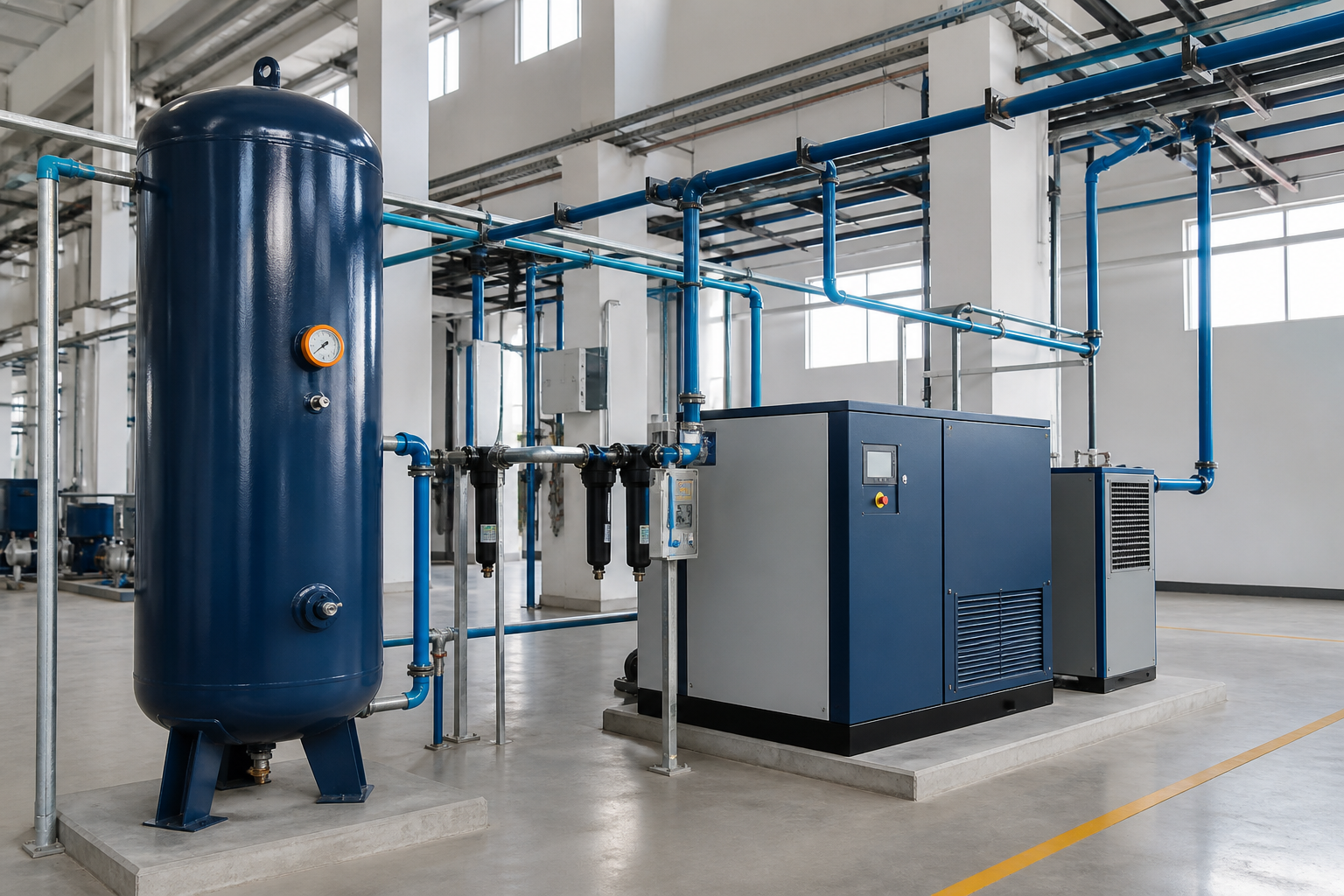
How to Size an Air Receiver Tank for Compressed-Air Systems
How to Size an Air Receiver Tank for Compressed-Air Systems
A practical buyer’s and plant-engineering guide to sizing compressed-air receiver tanks—covering storage purpose, pressure band, unload cycle time, calculation methods, installation layout and acceptance checks for factories in Faridabad and Delhi NCR.
Key takeaways
- Receivers smooth demand spikes and reduce compressor short-cycling.
- Size from compressor delivery, pressure band and desired unload interval.
- Use the next standard vessel size above the calculated volume.
- Place wet and dry receivers correctly in the treatment train.
Why air receivers matter
An air receiver is not just a pressure vessel. It stores energy, absorbs peak demand, protects dryer and filter performance, and gives the compressor time to unload. Undersized storage often shows up as frequent load/unload cycles, pressure hunting at machines, and higher energy use. Oversized storage wastes floor space and capital without fixing root demand problems.
What the receiver does in a plant system
In a typical factory network, the receiver buffers flow between generation and distribution. When several tools start together, stored air covers the shortfall until the compressor responds. When demand drops, the vessel holds pressure so the compressor can stay unloaded longer. That is why receiver sizing and compressor CFM selection should be planned together.
Core sizing formula
A widely used preliminary formula for receiver volume is:
Example: 8 m³/min delivery equals 8,000 L/min. With a 3-minute unload target and a 1.5 bar band (8.0 to 6.5 bar g), V = (8,000 × 3) ÷ 1.5 = 16,000 L. In practice, select the nearest standard vessel above that value and confirm with site duty data.
Pressure band and controls
A wider load/unload band reduces cycling but raises average system pressure and energy cost. A narrow band protects sensitive tools but demands more storage or faster compressor response. Match the band to the process minimum pressure plus distribution losses. If the plant already suffers pressure drop, fix piping and filters first—see the pressure-drop cost calculator.
Wet vs dry receivers
| Receiver type | Typical location | Primary benefit |
|---|---|---|
| Wet receiver | After compressor, before dryer | Cooling, condensate separation, compressor buffering |
| Dry receiver | After dryer and filters | Stable clean air at point-of-use peaks |
| Local receiver | Near high-pulse machines | Protects ring-main pressure from short bursts |
Many plants need both wet and dry storage. A wet receiver alone cannot protect dry air quality if downstream demand spikes pull wet untreated air through a bypass.
Rule-of-thumb checks
As a cross-check, many industrial systems start around 0.3–0.5 m³ of storage per m³/min of compressor capacity, then refine with the formula above. Continuous processes with flat demand may need less. Batch plants, CNC clusters, packaging lines and pulse tools often need more. Never use vessel connection size or floor space as the sizing method.
Installation and safety essentials
- Use vessels certified for the design pressure and local statutory requirements.
- Fit safety relief valves, drains and accessible isolation.
- Slope and drain condensate; automatic drains need maintenance access.
- Support the vessel properly and protect against vibration.
- Keep clearances for inspection, painting and statutory checks.
When to add storage instead of a bigger compressor
If short peaks drive frequent load events but average demand is moderate, extra receiver volume can be cheaper than a larger compressor. If average demand already exceeds free-air delivery, storage will not solve the shortage—revisit capacity with a measured demand study and the FAD calculator. Combine storage planning with leak control using the leakage cost calculator.
Acceptance checklist
- Confirm calculated volume, selected standard size and pressure rating.
- Verify wet/dry position in the treatment train.
- Record load/unload interval under representative production.
- Check drain operation and condensate handling.
- Confirm no unsafe bypass around dryers or filters during peaks.
Frequently asked questions
Is a larger receiver always better?
No. Excess volume costs money and space. Size for the control strategy and peak profile, then select the next standard vessel above the calculated need.
Can a receiver fix chronic low pressure?
Only if the issue is short demand spikes. Chronic low pressure usually means undersized compressors, leaks, or distribution losses.
Where should the receiver be installed?
Wet receivers usually sit after the compressor and before the dryer. Dry receivers sit after treatment. Local receivers help high-pulse machines.
How often should receiver drains be checked?
Automatic drains should be inspected on the plant PM schedule. Failed drains flood vessels and overload dryers.
Review your compressed-air storage plan with ITT India.
Share your compressor capacity, pressure band, peak tools and plant layout. Our Faridabad team can help you size wet and dry receivers as part of a complete system.
Air Receiver Tank: Engineering Support from ITT India
Use this air receiver tank sizing guide and calculator to estimate storage capacity, stabilize pressure and correctly plan an industrial compressed-air system.
Plan the right industrial solution
ITT India helps factories evaluate air receiver tank using operating demand, air quality, pressure, energy use, installation conditions and lifecycle service requirements. Our engineers can review your application before equipment selection or system modification.
Explore our compressed air products, use the technical calculators, or request an engineering consultation for Faridabad, Noida and Delhi NCR.