
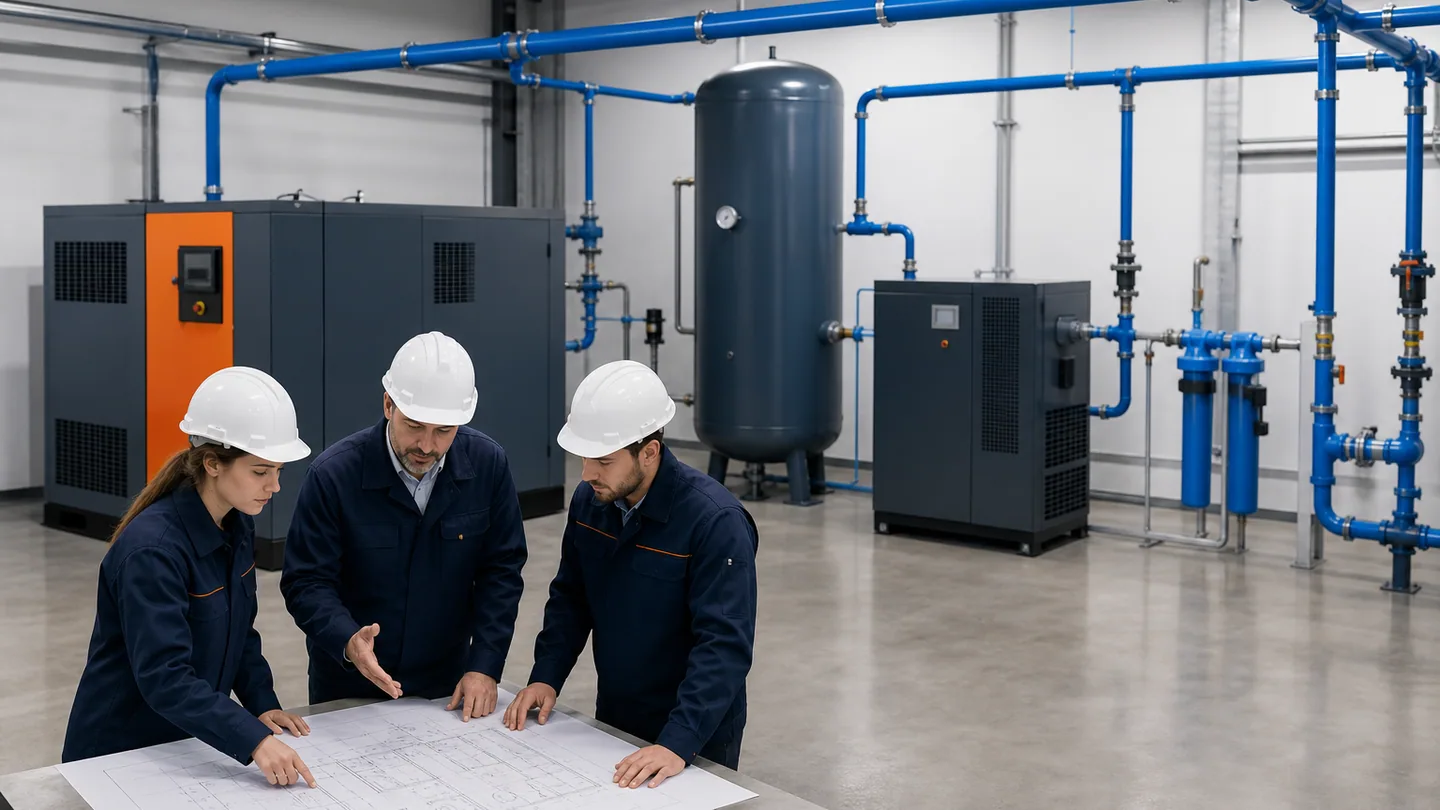
How to Design a Factory Compressed-Air System
How to Design a Factory Compressed-Air System
A step-by-step factory compressed-air design guide for demand, pressure, storage, drying, filtration, piping, controls, ventilation, safety and commissioning.
Key takeaways
- Define each process requirement before choosing equipment.
- Design from points of use back to the compressor room.
- Treat pressure, air quality, storage and controls as one system.
- Commission with measured flow, pressure, dew point and power.
1. Define the design basis
List all air users, required point-of-use pressure, flow, duty cycle, air quality and criticality. Record current shifts, expansion plans and consequences of interruption. In Faridabad and Delhi NCR, high summer temperature, dust and seasonal humidity should be included in compressor-room ventilation and dryer calculations rather than treated as afterthoughts.
2. Build the demand profile
Calculate average and peak simultaneous demand using the method in the CFM sizing guide. Where a plant already operates, log pressure, compressor state, flow and power over representative shifts. Separate productive demand from leaks and inappropriate uses such as open blowing.
3. Establish the pressure budget
Begin with the minimum pressure required at each machine. Allocate acceptable losses through point-of-use equipment, distribution piping, filters, dryers and controls. Group unusually high-pressure users or consider local solutions instead of raising pressure across the entire plant. Specify measurement points so the budget can be verified during commissioning.
4. Select generation and control strategy
Compare compressor types and capacities at the required pressure and ambient conditions. Consider demand variability, minimum turndown, unloaded power, starts per hour, redundancy and maintenance windows. Multiple machines require a sequencing strategy; without it, pressure bands can overlap and machines may run inefficiently.
5. Size receivers for a purpose
Receivers provide storage, stabilise pressure and can reduce rapid cycling, but they do not create compressor capacity. Required volume depends on flow imbalance, allowable pressure change, event duration and control response. Locate wet and/or dry receivers according to the treatment layout and provide certified safety devices, drains, inspection access and statutory compliance.
6. Specify air treatment
Define particulate, water and oil requirements at each process. Choose dryers using pressure dew point, inlet temperature, ambient condition, flow and pressure—not only pipe size. Select filters for required class and monitor differential pressure. Provide reliable condensate separation, drains and compliant disposal. Read the dryer selection guide for a practical decision process.
7. Design the distribution network
A looped ring main can improve pressure stability and provide two flow paths. Size mains and drops using calculated flow and allowable pressure loss. Use long-radius fittings where practical, isolate production areas, take drops appropriately to reduce liquid carryover, and provide accessible drains. Compare materials using the aluminium versus PPR guide.
8. Compressor-room and safety design
- Provide cool, clean intake air and discharge hot cooling air outdoors where suitable.
- Prevent recirculation and verify ventilation at peak ambient temperature.
- Allow service clearances, lifting access, lighting and safe drainage.
- Provide electrical protection, earthing and isolation.
- Install approved pressure relief and pressure equipment.
- Control noise and restrict unauthorised access.
9. Commission and baseline the system
Leak-test the installation under an approved procedure, verify safety devices and drain operation, then run at representative demand. Record compressor pressure, critical point pressure, flow, power, dryer dew point, filter differential pressure, temperatures and control sequence. Train operators and hand over as-built drawings, setpoints, spare-parts list and maintenance schedule.
Frequently asked questions
Is a ring main always required?
Not always, but it often improves pressure stability and flexibility in plants with distributed users. Model the actual layout and flow.
Should a factory design for maximum possible expansion?
Design for approved, plausible growth and retain modular options. Extreme speculative oversizing can reduce control efficiency.
What should be measured at commissioning?
At minimum: flow, power, pressures, temperatures, dryer dew point, filter differential pressure, drain function and control sequence.
Review your compressed-air requirement with ITT India.
Share your process, demand profile, pressure, air-quality requirement and plant location. Our team can help you plan the next technical step without unsupported performance claims.